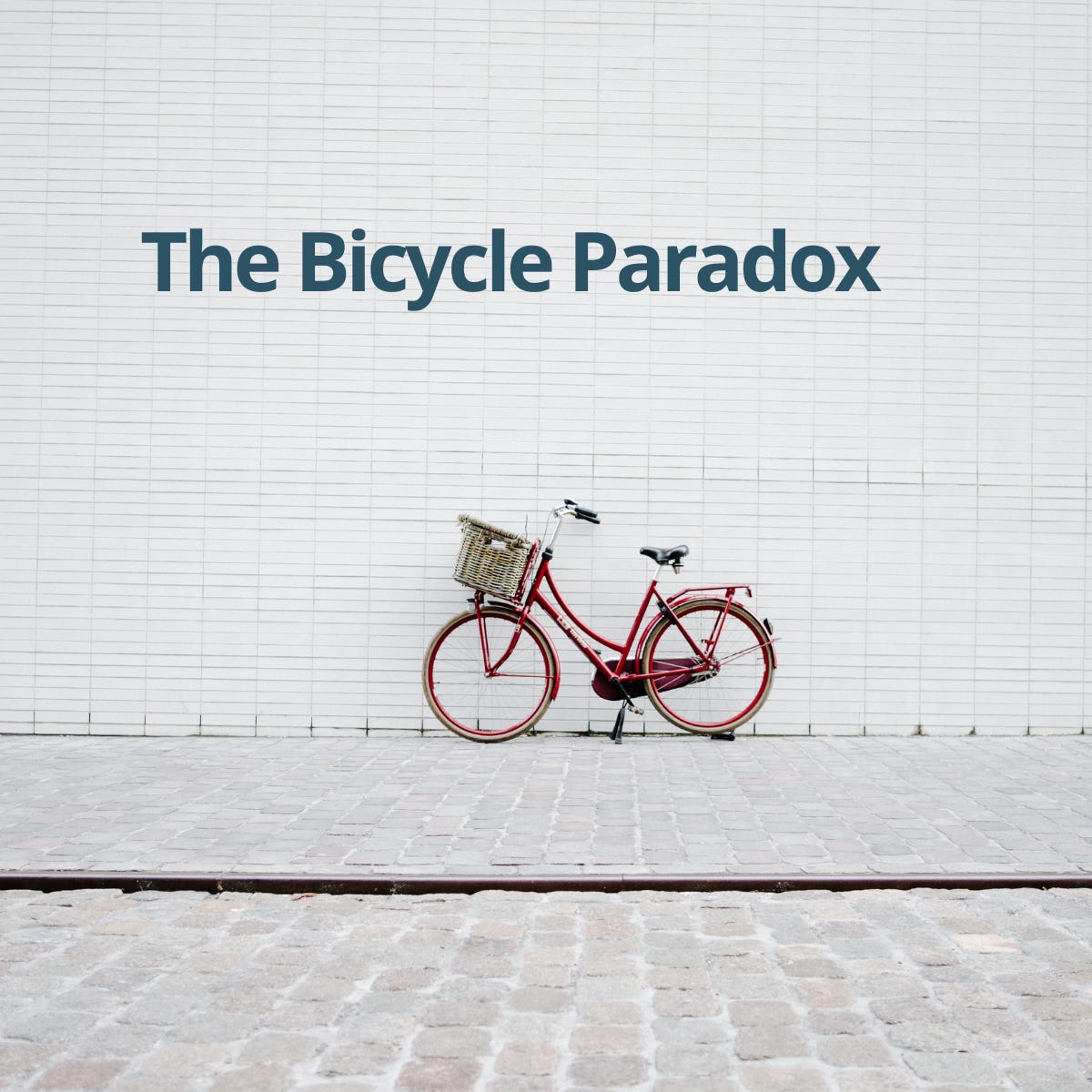
When I began writingSim | Rx™: Transforming Healthcare, Leadership & Culture by Design, I searched for one image that captured the heart of why this work matters.
I found it in the memory of a bicycle.
Excerpt from Sim | Rx™:
Imagine learning to ride a bicycle…
You can read books on balance, study the mechanics, become versed in physics, and even watch experts ride. But until you place your hands on the handlebars, feel the ground beneath your tires, and experience that first shaky pedal—you haven’t truly learned.
This is The Bicycle Paradox.
In education, leadership, and life—we often mistake knowledge for mastery. But knowledge without experience is like a bicycle without a rider. It’s potential without purpose.
That wobble. That fall. That foot serving as a kickstand.
That’s growth.
And it’s needed.
And the more you ride, the more you become.
You go from struggling to balance to gliding confidently.
From riding alone to exploring with others.
From cautious steps to skillful moves.
Sim | Rx™ is designed to close that gap.
It’s not about passive learning—it’s about active experience.
It’s about creating spaces where people can try, test, fail safely, and grow confidently.
Because in a world that values information, true transformation is found in application.
What follows is our prescription—one designed to restore connection, build competency, and unlock compassion at every level.
Let’s ride.
Pep Talks with Eric is a reader-supported publication. To receive new posts and support my work, consider becoming a free or paid subscriber.
Why It Matters Now
That moment—the first shaky pedal—is the reason Sim | Rx™ exists.
It reminded me that transformation never begins in a classroom; it begins in motion.
We don’t learn empathy by hearing about it.
We learn it by living it—in real moments of pressure, presence, and partnership.
Yet, in healthcare and leadership today, we’ve built entire systems that expect mastery without movement.
PowerPoints without practice.
Policies without people.
The Bicycle Paradox challenges that.
It calls us back to embodied learning—the kind that reconnects hands, hearts, and minds.
That’s what Sim | Rx™ was designed to do:
to bridge the gap between thinking and doing, between education and experience, between efficiency and empathy.
Because when people feel safe to try, to wobble, and to learn together, that’s when humanity returns to the system.
From The Why Series
Each week, I’ll share one “why” behind Sim | Rx™—a look at the human stories, metaphors, and design principles that brought this work to life.
Next week → The Toddler Approach: Why We Don’t Need Perfect Practice—We Need Permission to Practice.